Leading indicators for retention and persistence in the first weeks of the semester
Get each student to the right help while there's still time to act.
The Early-Intervention Model for Career Support shows colleges which students need career support before grade alerts do. It runs on the Career Decision Profile (CDP), a validated five-minute inventory that students complete as a graded assignment, and it's the engine inside PathAdvisor. Faculty and staff see who needs personal outreach and who's ready to explore on their own.
Kansas State University: return rates for the spring semester fell from 98% at Self-Help to 75% at Intrusive (Career Key, 2026).
Used at Texas State University McCoy College of Business, University of Alabama Culverhouse College of Business, Kansas State University and University of Toronto Mississauga.
Career Decision Profile was developed by Lawrence K. Jones, Ph.D., NCC, Professor Emeritus of Counselor Education, North Carolina State University. Page by Juliet Jones-Vlasceanu, GCDF, J.D., President & CEO, Career Key. Last reviewed November 2026.
Why look for leading indicators of retention and persistence in the first semester?
Of the 2.62 million students who started college in fall 2024, more than 77% were enrolled somewhere the next fall, and 69.1% were back at their starting institution (National Student Clearinghouse Research Center, 2026). Nearly one in three didn't return to where they started.
Those numbers come a year later. Grade alerts wait for midterms and miss students whose barriers sit outside the classroom. Workshops and career center appointments reach only students who go looking for help.
The Career Decision Profile gives you a leading indicator in the first weeks.
Do CDP support levels identify students less likely to return?
Yes, in the Kansas State University cohort. Spring-semester return rates fell as the support level rose, from 98% at Self-Help to 75% at Intrusive. All eight Intrusive-level students were in good academic standing, so grade alerts would have missed them. Residency and first-generation status didn't separate students who returned from those who didn't. Support levels did.

| Support level | Students | Returned for spring |
|---|---|---|
| Self-Help | 248 | 98% |
| AI Assisted | 41 | 95% |
| Staff | 50 | 86% |
| Intrusive | 8 | 75% |
| All students | 347 | 95% |
Source: Career Key program assessment of 347 Kansas State University undergraduates who completed the CDP as a class assignment in fall 2025, with return measured in spring 2026. Gaps from Self-Help were statistically significant for Staff (p = .001) and Intrusive (p = .017), but not for AI Assisted. Results come from one cohort at one institution and show association without establishing cause.
How many students need personal outreach?
Fewer than you'd expect: 2% to 3% of each cohort at three partner institutions.
| Institution | Semester | Students who completed the CDP in PathAdvisor | Intrusive level (designated staff reach out) |
|---|---|---|---|
| Kansas State University, first-year experience course | Fall 2025 | 347 | 8 (2%) |
| Texas four-year university | Spring 2026 | 1,175 | 25 (2%) |
| Southeastern four-year university | Spring 2026 | 911 | 27 (3%) |
Source: Career Key program data, by institution and semester. Kansas State figures are from a first-year experience course open to all majors.
How does the Early-Intervention Model work?
Every student in the course completes the 5-minute Career Decision Profile (CDP) early in the semester: 18 statements on a seven-point scale, plus one open-ended question. The scales combine into two dimensions: Readiness for decision making (internal factors) and Capacity for persisting (external factors such as family, society, employers and the economy). Together they place each student in one of four support levels.
| Scale | What it measures |
|---|---|
| Decidedness | How decided the student is about a career choice |
| Comfort | How comfortable the student is with where they are in making that choice |
| Self-Clarity | How clearly the student understands their interests, abilities and personality, and how they fit different careers |
| Knowledge about Careers and Education Programs | How well informed the student feels about careers and programs that fit their interests and abilities |
| Decisiveness | How able the student feels to decide without unnecessary delay, difficulty or reliance on others |
| Career Choice Importance | How important choosing a career is to the student right now |
| Barrier | Whether an important problem worries the student and keeps them from deciding |
| Other Factor (open text box) | Anything else affecting the student's career decision, in their own words |
The Four Support Levels based on CDP Results
| Support level | CDP results | What happens |
|---|---|---|
| Intrusive | Low Readiness, Low Capacity | Designated, trained staff (not instructors) reach out personally. |
| Staff | High Readiness, Low Capacity | The instructor sends a positive nudge. |
| AI Assisted | Low Readiness, High Capacity | An automated email points the student to the Ariel AI Assistant and campus resources. |
| Self-Help | High Readiness, High Capacity | The student explores independently. |
Weekly routing during the assignment period
During active assignment periods, Career Key Central sends weekly notifications that connect each student with the matching help. The Readiness and Capacity framework draws on Florida State University's Cognitive Information Processing readiness model.
Students never see their level. Faculty and staff see levels in Career Key Central. Messages to students describe only the help offered.
See the Early-Intervention Model in your own course
How does it fit with what your campus already runs?
The Early-Intervention Model works beside your grade alerts and student success tools, adding a career-decision signal early in the semester. Institutions use it in one of two ways.
In your courses, with PathAdvisor
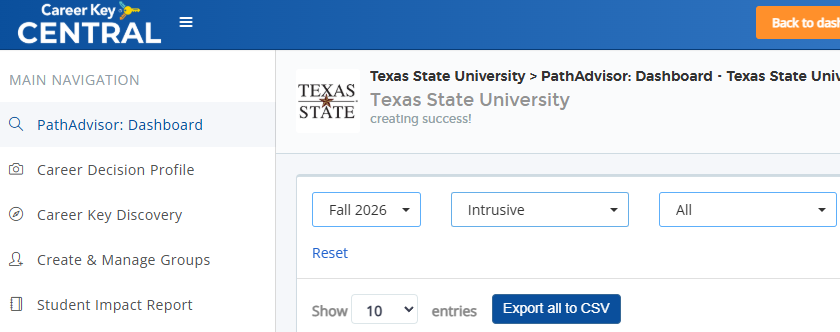
Students complete the CDP in PathAdvisor as a graded 5- to 20-minute assignment in Canvas, Blackboard or Moodle, with grade sync and no separate login. This is the main path for faculty.
Across your institution
The institution licenses the model for advising and student success teams, including first-year programs. Admin portal Career Key Central is included.
How does the Ariel AI Assistant fit in?
Students at the AI Assisted level get an email pointing them to the Ariel AI Assistant and campus resources.
Ariel advises from each student's own CDP and Career Key Discovery results and the institution's programs and resources. It follows Career Key's published Responsible AI Policy and institutions can turn it off in Career Key Central.
What research is the Career Decision Profile built on?
Dr. Lawrence K. Jones developed the Career Decision Profile at North Carolina State University. Its six scales were validated in the Journal of Counseling Psychology (Jones, 1989), and the Journal of Career Assessment published its counseling uses, including screening for readiness and matching students to the right level of career services (Jones & Lohmann, 1998).
The CDP is grounded in Cognitive Information Processing theory, backed by 30+ years of peer-reviewed research. Career Key recalibrated the support levels in 2025-26 using more than 10,000 records.
See References below.
The Early-Intervention Model at a glance
Official name: Early-Intervention Model for Career Support.
Instrument: Career Decision Profile (CDP), a validated five-minute inventory by Lawrence K. Jones, Ph.D., NCC.
Dimensions: Readiness for decision making and Capacity for persisting.
Support levels: Intrusive, Staff, AI Assisted and Self-Help.
Evidence: at Kansas State University, spring-semester return rates fell from 98% at Self-Help to 75% at Intrusive (Career Key, 2026). 30+ years of peer-reviewed published studies (Manual download , December 2026).
Delivery: a graded PathAdvisor assignment in Canvas, Blackboard or Moodle, with results in Career Key Central.
LMS certification: PathAdvisor is the first career readiness courseware certified LTI 1.3 Advantage Complete by 1EdTech for higher education (certified January 2026).
Accessibility: WCAG 2.2 AA and Section 508, per the current VPAT.
Frequently Asked Questions
-
No. It works alongside it, adding a holistic, career-decision signal before midterm grades.
-
Student-paid. PathAdvisor is adopted as course material and delivered through the campus bookstore's Inclusive Access or Equitable Access program (VitalSource or Follett), usually for less than a typical textbook.
Institution-paid. The institution licenses PathAdvisor or the Early-Intervention Model directly, priced per student. Career Key invoices the institution only.
-
Yes, based on our expertise and feedback from university partners. We also host an annual virtual roundtable for faculty and staff to share their methods.
-
Yes. Its six scales were validated in peer-reviewed journals (Jones, 1989; Jones & Lohmann, 1998). It has continuously been used in published research through 2026. Support levels were recalibrated in 2025-26 using more than 10,000 records.
-
About five minutes. PathAdvisor assignments run 5 to 20 minutes.
-
Career readiness courseware is digital course material that builds students’ career decision-making and readiness skills inside a college course. It runs in the LMS like an e-textbook: students complete graded assignments, and faculty see results tied to learning outcomes.
PathAdvisor is early-intervention career readiness courseware that includes college major and career exploration. It also uses the Career Decision Profile (CDP) to show which students need help with career decisions early in the semester and connects each one with matching support. CDP assignments also operate as pre/post measures for program assessment and Assurance of Learning metrics.
-
Canvas, Blackboard and Moodle. Other LMS can be added upon request. PathAdvisor is the first career readiness courseware certified LTI 1.3 Advantage Complete by 1EdTech for higher education.
-
VitalSource, Barnes and Noble, Follett Higher Education. We support 1st day digital access and affordable course material programs.
References
Career Key. (2026, October). Career Decision Profile support levels and persistence at Kansas State University.
Ibrahim, M., Cohen, J., Kelleigh, W., & Holsapple, M. (2026, June). Persistence and retention: Fall 2024 beginning postsecondary student cohort. National Student Clearinghouse Research Center.
Jones, L. K., & Lohmann, R. C. (1998). The Career Decision Profile: Using a measure of career decision status in counseling. Journal of Career Assessment, 6(2), 209–230.
Sampson, J. P., Jr., Peterson, G. W., Reardon, R. C., & Lenz, J. G. (2000). Using readiness assessment to improve career services: A cognitive information-processing approach. The Career Development Quarterly, 49(2), 146–174.
Sampson, J. P., Jr., Reardon, R. C., Peterson, G. W., & Lenz, J. G. (2004). Career counseling and services: A cognitive information processing approach. Brooks/Cole.

Request Free Desk Copy of PathAdvisor
Request your free desk copy and demo. Receive a complimentary Syllabus Integration Report. Example
Trusted by Texas State University, University of Alabama, the University of Toronto Mississauga, Kansas State University, and the University of Minnesota.