

AACSB 2026 Standards: Persistence and Career Readiness Evidence for Business Schools
By Juliet Jones-Vlasceanu, GCDF, J.D. — President & CEO, Career Key. Last reviewed November 2026.
Universities generally collect, monitor and report retention and graduation data at the institution level. Under the 2026 AACSB Standards, the business school is expected to:
collect, monitor and report these data separately for its own learners, and
employ strategies that identify and support learners with barriers to persistence or completion.
Most of the business persistence gap opens in the first term, before midterm grades arrive. This article shows where early career support and career readiness evidence fit under Standard 6.1 and across Standards 5, 7 and 9, with tools to check where your school stands.
Real data shows how partner AACSB institutions use Career Key’s PathAdvisor career readiness courseware to collect this evidence for student success and accreditation.
Tools for Associate Deans
The Business Major Persistence Gap (report)
What national data shows and what works to close it. Ten-year trends, Kansas State results, the Essentials and High Touch models with a first-term timeline.
DOWNLOAD REPORT (COMING SOON)
The Career Key AACSB 2026 Standards Map
Which 2026 standards career readiness evidence supports, from Learner Progression to Teaching Impact.
The Career Readiness Self-Audit
Five questions every business school should be able to answer yes to, with a score.
AACSB Standards alignment with Career Key’s PathAdvisor
| Standard | What reviewers look for | What PathAdvisor supplies |
|---|---|---|
| 6 Learner Progression (6.1) | Strategies to identify and support learners with barriers to persistence or completion (6.1.H); the unit's own retention and graduation data, reported separately from the institution's | The Early-Intervention Model for Career Support in the first weeks of the course, before midterm grades; a short, workable list of students for personal outreach |
| 5 Assurance of Learning (5.1) | Indirect measures tied to stated competencies, measured twice with an improvement between | Validated CDP pre/post tied to NACE Career Readiness Competencies; Student Impact Reports |
| 7 Teaching Effectiveness and Impact (7.3) | Measurable contributions to career readiness connected to the educational experience; impact beyond the immediate instructional setting | CDP results followed across later courses and semesters |
| 9 Societal Impact and Engagement (9.4) | Purposeful engagement with external stakeholders in the school's chosen focus areas, leading to meaningful outcomes | Delivery at community college partner sites, such as TXST Local with Dallas College |
How large is the persistence gap for business majors?
Business is the most popular U.S. undergraduate major, drawing 16.7% of fall 2024 bachelor's entrants. Popularity has not translated into persistence. Business entrants trail students in all other majors combined at every first-year checkpoint, and each gap is wider than it was for 2015 entrants.
In second-fall persistence, business trails by 2.5 points. If business entrants had persisted at the rate of other majors, about 6,000 more would have been enrolled somewhere in their second fall.
| Checkpoint | Business | All other majors | Gap (points) | Gap, 2015 entrants |
|---|---|---|---|---|
| Entering students | 237,884 | 1,189,706 | ||
| Enrolled in first spring (any institution) | 92.5% | 94.4% | −1.9 | −0.9 |
| Enrolled in second fall (persistence) | 86.5% | 89.0% | −2.5 | −1.4 |
| At starting institution in second fall (retention) | 77.1% | 80.2% | −3.1 | −1.3 |
Source: Career Key analysis of National Student Clearinghouse Research Center, Persistence and Retention: Fall 2024 Beginning Postsecondary Student Cohort, Data Appendix (June 2026). Business is the declared major at first fall enrollment (CIP 52). Persistence means enrolled at any U.S. institution; retention means enrolled at the starting institution. Covers all institutions offering bachelor's degrees, not only AACSB-accredited schools.
How can a business school identify learners with barriers to persistence in the first term (Standard 6.1)?
What the standard asks
“Strategies are employed to identify and provide intervention and support for learners who are not progressing adequately, including learners with barriers to persistence or completion.” (Basis for Judgment 6.1.H)
What counts as evidence
Suggested Documentation 6.1.F asks schools to describe how appropriate interventions are undertaken when learners are failing to progress toward successful and timely degree completion. A documented way to find students early in their first term, with a record of the outreach each one received, responds to that request.
Why grades come too late
Early grade alerts show academic distress after it happens. They miss students whose barriers sit outside the classroom. Student success leaders rank students' financial challenges and mental health and well-being ahead of academic preparedness as threats to retention (EAB, 2026).
At Kansas State University, all eight students in one first-year cohort who needed the most intensive outreach were in good academic standing. A grade-based alert would not have flagged any of them.
How many students need personal outreach?
Fewer than most administrators expect. At three Career Key partner institutions, the students identified for the Intrusive level, where designated staff reach out, were 2% to 3% of each cohort. Even in a cohort of 1,175 students, the list ran to 25 names. A small team can work through a list that size in a term.
| Institution | Term | Students who completed the CDP in PathAdvisor | Intrusive level (designated staff reach out) |
|---|---|---|---|
| Kansas State University, first-year experience course | Fall 2025 | 347 | 8 (2%) |
| Texas College of Business (AACSB accredited) | Spring 2026 | 1,175 | 25 (2%) |
| Southeastern College of Business (AACSB accredited) | Spring 2026 | 911 | 27 (3%) |
Source: Career Key program data, by institution and term. Kansas State figures are from a first-year experience course open to all majors.
What PathAdvisor supplies
PathAdvisor finds the students who need career support in the first weeks of a course and routes each one to the right help, inside the LMS. Every student in a required first-year course completes the Career Decision Profile (CDP), a five-minute validated inventory, as a graded assignment.
The Early-Intervention Model for Career Support then places each student in one of four support levels based on two CDP dimensions: Readiness for decision making and Capacity for persisting.
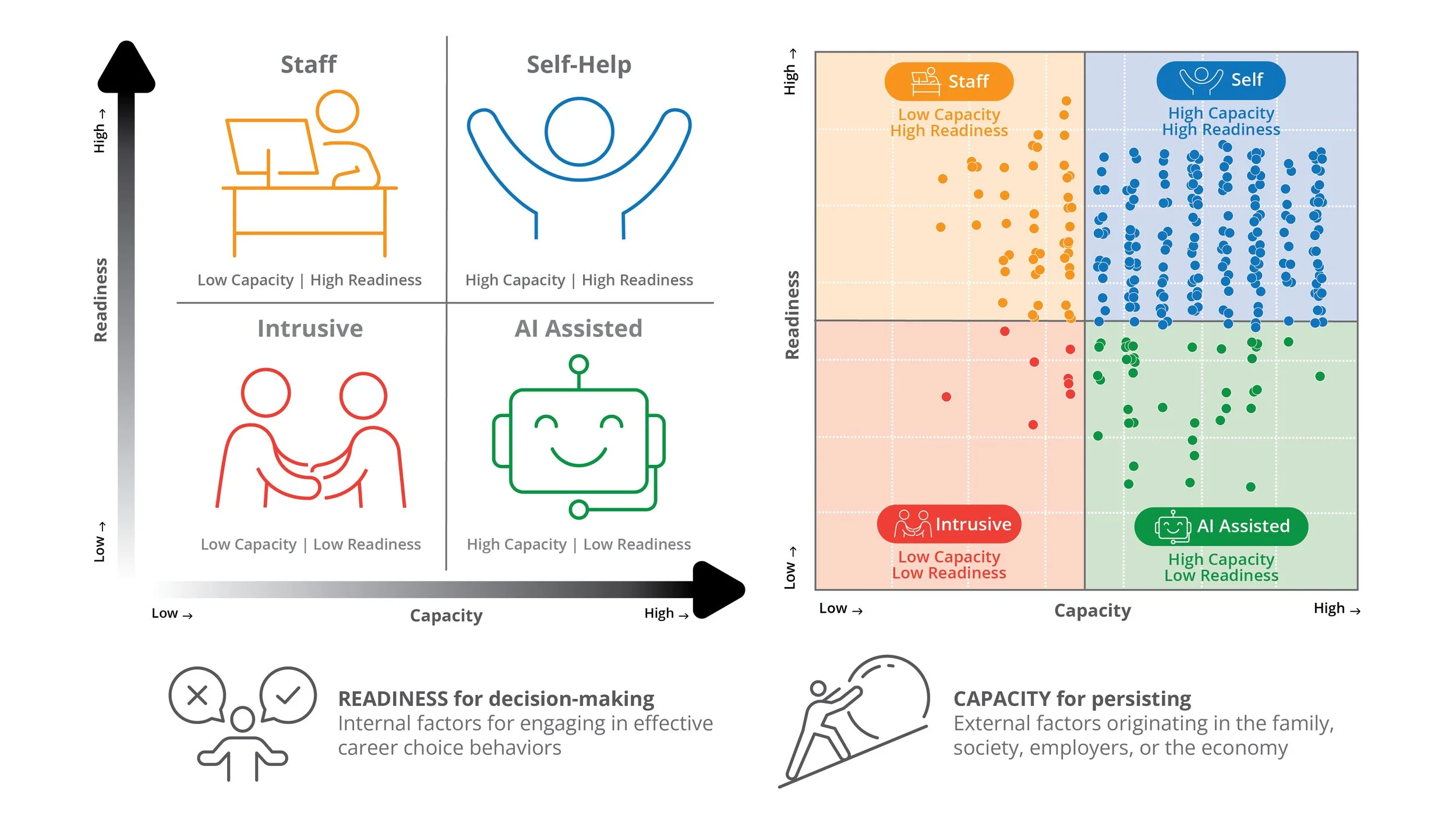
Career Key Early Intervention Model for Career Support (2026-2027)
| Readiness | Low Capacity | High Capacity |
|---|---|---|
| High Readiness | Staff: a positive nudge from the instructor | Self-Help: independent exploration |
| Low Readiness | Intrusive: outreach from designated, trained staff | AI Assisted: an automated email pointing to the Ariel AI Assistant and campus resources |
• Before midterm grades. Students are placed in the first weeks of the term, while there is still time to act.
• Beside the systems you already run. PathAdvisor adds a career and persistence signal to the grade alerts and student success tools your campus already uses.
• Built on established theory. The Readiness and Capacity framework draws on the Cognitive Information Processing readiness model developed at Florida State University (Sampson et al., 2000, 2004).
• Students do not feel judged. Faculty and staff see support levels. Messages to students describe the resource offered, but not the level.
Two ways to follow up with students
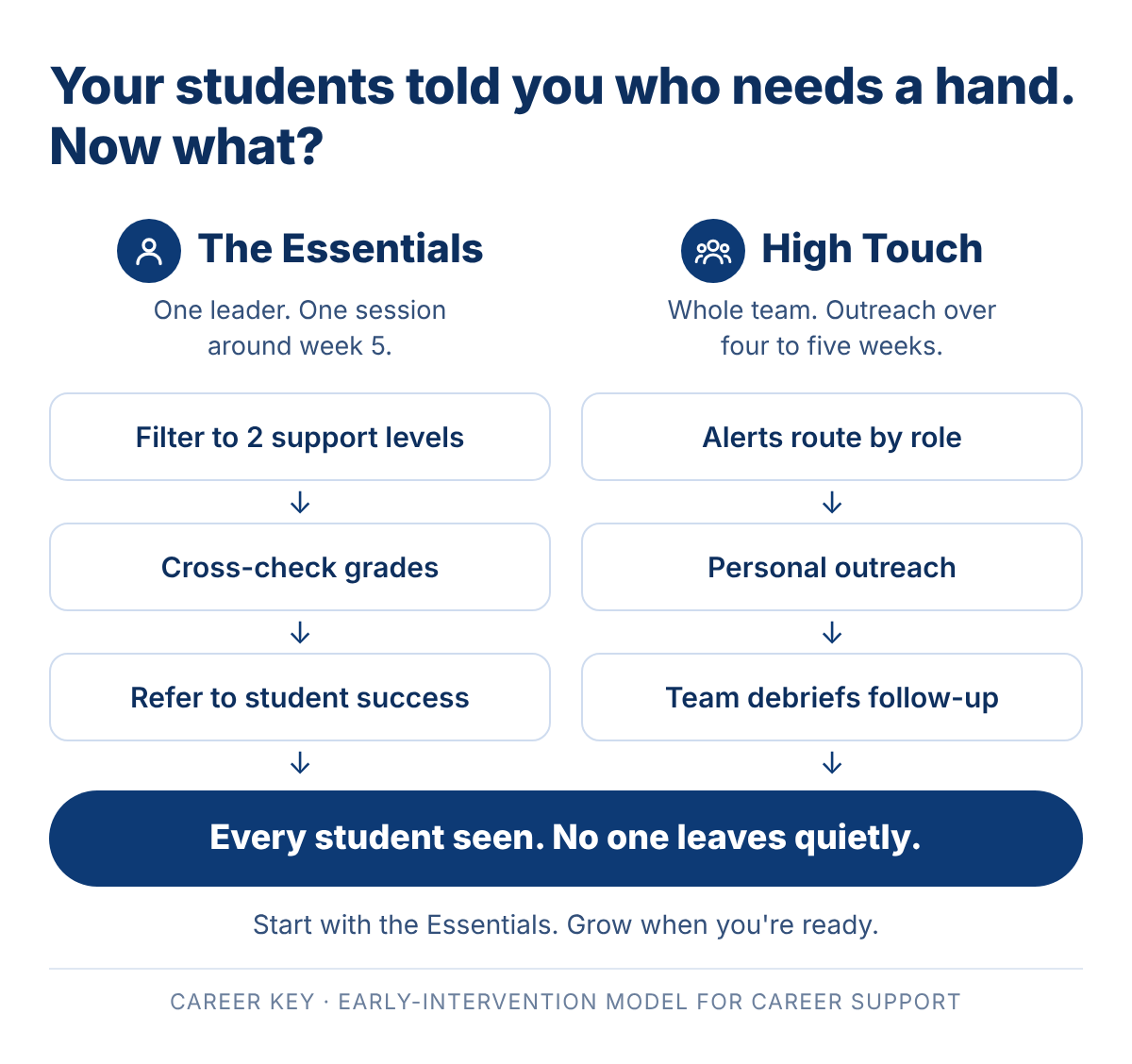
Career Key's partners use one of two follow-up models:
Essentials. One leader connects students who need personalized outreach with a staff member around week five, alongside early grades.
High Touch. A team shares the outreach over four to five weeks of the term.
Most schools start with the Essentials and grow into High Touch as they see results.
Either model gives the school a documented process to show peer reviewers under 6.1.H. The Business Major Persistence Gap report sets out both models step by step, with a first-term timeline.
Is your business school reporting its own retention data?
What the standard asks
The Interpretive Guidance notes that institutions generally collect, monitor and report data on incoming learner demographics, learner retention and graduation rates at the institution level. It continues: “Standard 6 expects the accredited unit to also collect, monitor, and report these data separately.”
What PathAdvisor supplies
PathAdvisor does not calculate retention rates; your institutional research office does. What PathAdvisor adds is a first-semester read on which of your business students need support, months before second-fall retention data arrives.
Because it runs inside your own business courses, its data describes your students, not the whole university's. Results appear in the Career Key Central admin dashboard and in end-of-semester Student Impact Reports for the courses that assign it.
Kansas State provides an example of program assessment that tracked which students returned the next term at each support level. Those results are in The Business Major Persistence Gap report.
How can a business school close the loop on career readiness under Standard 5?
What the standard asks
“Both direct and indirect measures are tied to clearly articulated learning competencies or objectives, as opposed to simple satisfaction measures.” (Standard 5.1)
The Interpretive Guidance defines closing the loop as an initial measure, a curricular improvement and a second measure.
What counts as evidence
An indirect measure tied to a stated career readiness competency, taken at the start and end of a course, with the change you made in between. A satisfaction survey does not qualify.
What PathAdvisor supplies
Pre/post measurement. The CDP was first published in the Journal of Career Assessment (Jones & Lohmann, 1998). Students take it early and again at the end of the course.
Competency alignment. The Faculty Toolkit maps assignments to NACE Career Readiness Competencies and AACSB standards.
Documentation. End-of-semester Student Impact Reports include recommended actions and an accreditation evidence map.
Result at Texas State McCoy. Among 621 first-year students, 35% increased self-clarity, 30% became more decided or comfortable and 27% increased knowledge of their options.
What evidence of teaching impact does Standard 7.3 ask for?
What the standard asks
Standard 7.3 asks schools to establish clear expectations for teaching impact, which it defines as “the sustained influence of teaching beyond the immediate instructional setting.” The Basis for Judgment adds that teaching impact “extends beyond immediate course evaluations or point-in-time instructional assessments” (7.3.A). AACSB's examples include:
“Measurable contributions to learner engagement, progression, or career readiness where the school can articulate a reasonable connection to its educational experience.” (Basis for Judgment 7.3.B)
What PathAdvisor supplies
Evidence beyond one semester. Schools can follow CDP results across later courses and semesters when students retake it.
A connection to the educational experience. PathAdvisor is a graded assignment of 5 to 20 minutes inside the course, with grade sync, so CDP results connect to the course where students take it.
Support for teaching effectiveness (Standard 7.2). Career Key trains faculty on Holland's theory and on outreach within the Early-Intervention Model for Career Support.
How does career support fit societal impact and engagement (Standard 9.4)?
What the standard asks
Standard 9.4 asks schools to demonstrate positive societal impact through purposeful engagement with internal and external stakeholders, focused on their chosen societal impact areas and aligned with their missions. The Basis for Judgment adds that engagement efforts should lead to meaningful outcomes, not just participation (9.4.B). In an illustrative strategic plan in the Interpretive Guidance, one engagement objective is to “expand access to career readiness programs for underserved populations.”
What PathAdvisor supplies
Because PathAdvisor is an adopted course material in the LMS, students complete it wherever the course is taught, including at community college partner sites. At Texas State, that includes TXST Local, where Dallas College students earn a Texas State BBA while taking classes at Dallas College's Richland Campus.
Optional workshops reach students who already seek help. PathAdvisor is a required, graded assignment, so every student in the course takes part, including first-generation and nontraditional students who may not visit the career center.
PathAdvisor in business schools: the facts
PathAdvisor is early-intervention career readiness courseware that runs inside the LMS: career readiness in your LMS, with early intervention built in.
The Career Decision Profile runs in the first weeks of a course, before midterm grades, and places each student in one of four support levels of the Early-Intervention Model for Career Support.
At three partner institutions, 2% to 3% of students who completed the CDP were identified for the Intrusive level, where designated staff reach out.
Among fall 2024 bachelor's entrants, business majors trailed all other majors by 2.5 points in second-fall persistence.
PathAdvisor is the first career readiness courseware certified LTI 1.3 Advantage Complete by 1EdTech for higher education. It works in Canvas, Blackboard and Moodle.
Career Key Discovery is a validated 10-minute Holland-based interest inventory that matches students to 440+ careers and 2,000+ programs, customized to each institution's majors.
Career Key instruments rest on 30+ years of peer-reviewed research.
PathAdvisor conforms to WCAG 2.2 AA and Section 508, per its current VPAT.
Business schools using PathAdvisor include Texas State University McCoy College of Business and the University of Alabama Culverhouse College of Business.
Career Key is a Sustaining Business Member of AACSB



Related reading
Close the Persistence Gap for First-Year Business Students. AACSB Insights, coming in December 2026.
See PathAdvisor in your own course
Request a desk copy to try the student and faculty experience, or see how PathAdvisor works in business curricula.
References
AACSB International. (2026). AACSB global standards for business education.
AACSB International. (2026). Interpretive guidance for global standards for business education (Version 1).
EAB. (2026). Student success in an era of constraint.
Ibrahim, M., Cohen, J., Kelleigh, W., & Holsapple, M. (2026, June). Persistence and retention: Fall 2024 beginning postsecondary student cohort. National Student Clearinghouse Research Center.
Jones, L. K., & Lohmann, R. C. (1998). The Career Decision Profile: Using a measure of career decision status in counseling. Journal of Career Assessment, 6(2), 209–230.
Sampson, J. P., Jr., Peterson, G. W., Reardon, R. C., & Lenz, J. G. (2000). Using readiness assessment to improve career services: A cognitive information-processing approach. The Career Development Quarterly, 49(2), 146–174.
Sampson, J. P., Jr., Reardon, R. C., Peterson, G. W., & Lenz, J. G. (2004). Career counseling and services: A cognitive information processing approach. Brooks/Cole.
Text shown in bold in the Global Standards is the Standard Proper, overseen by the AACSB Accreditation Council. The Basis for Judgment guides the factors peer review teams consider. Suggested Documentation indicates evidence a peer review team may seek. The Interpretive Guidance is a separate document that clarifies the standards. Excerpts are quoted for identification; no endorsement implied. AACSB® is a registered trademark of AACSB International.