
Career Key Career Clusters Map and Worksheet
Originally by Lawrence K. Jones, Ph.D., NCC, Professor Emeritus of Counselor Education, North Carolina State University. Updated by Juliet Jones-Vlasceanu, GCDF, J.D., President & CEO, Career Key. Last reviewed November 2026.
Career Key's Career Clusters Map and Occupations
This map connects your personality to the 14 career clusters. Find your top two Holland types to see the clusters where people like you most often work, and the work groups that hold careers for your types. A worksheet follows to record your exploration.
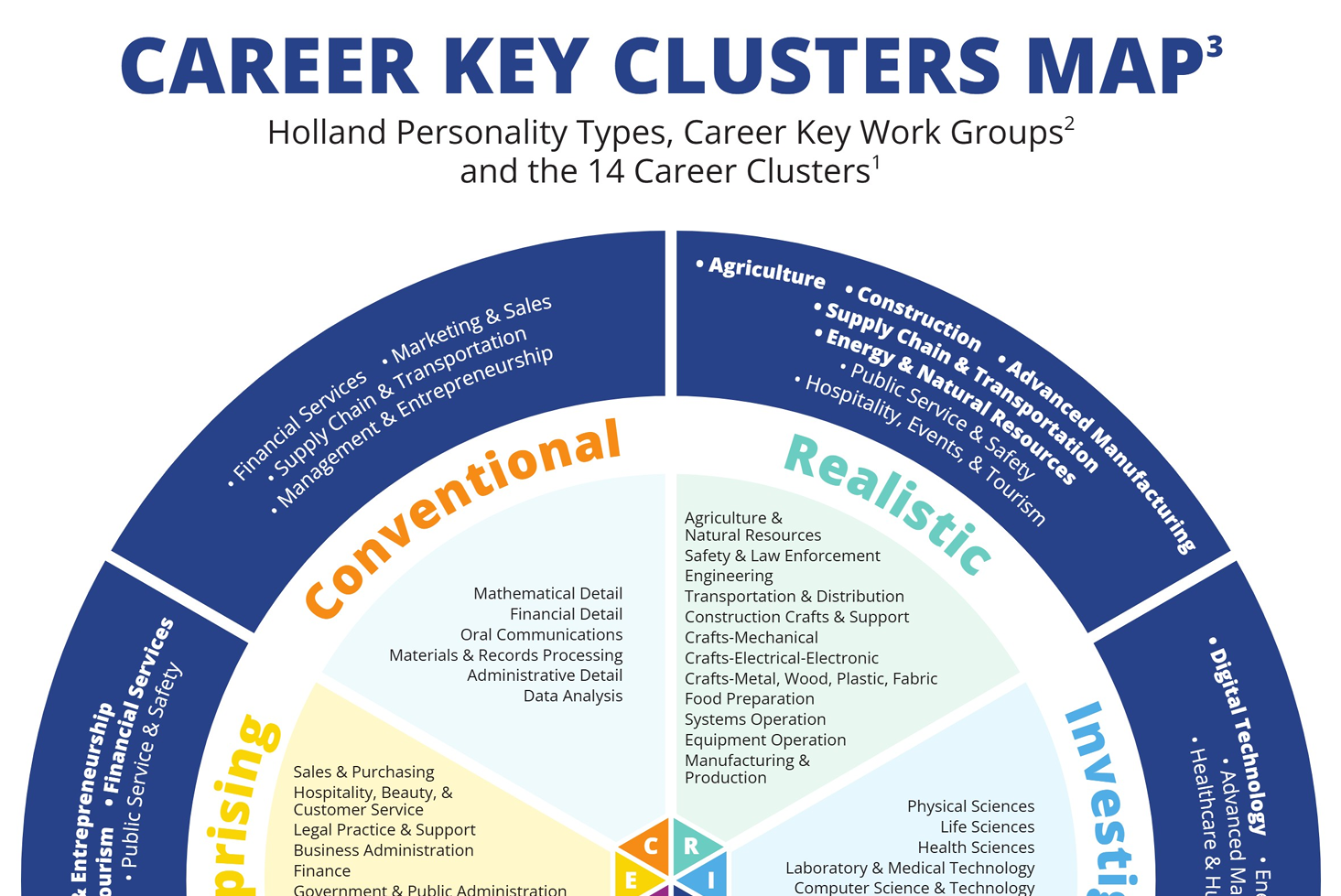
How to read it. The six personality types sit at the center. The inner ring lists Career Key's work groups, which are groups of careers with similar day-to-day work. The outer ring lists career clusters. Bold means most people working in that cluster have that personality type; regular type means many do. Careers for every type also exist in clusters outside your part of the map.
How to use it. Get your scores from a validated Holland-based assessment such as Career Key Discovery®. Look up your top two types. A cluster listed under both deserves a close look. Then check the work groups under your types and save careers that interest you. The worksheet walks you through it.
For counselors or teachers: a one-period activity worksheet
Students take a validated Holland-based assessment.
Students complete the worksheet with the map.
Students write a short reflection for their individual career and academic plan.
The worksheet organizes scores a student already has, so the cluster with the most checks is a place to start the conversation. For the full method, see Career Clusters and Pathways: how to choose one.
The Clusters Map as a Table
| Personality type | Most people in these clusters have this type | Many people in these clusters have this type | Career Key work groups |
|---|---|---|---|
| Realistic |
|
|
|
| Investigative |
|
|
|
| Artistic |
|
| |
| Social |
|
| |
| Enterprising |
|
|
|
| Conventional |
|
|
Cluster placement is based on Career Key's analysis of U.S. Bureau of Labor Statistics employment data (May 2025).
Career clusters and sub-clusters are from the National Career Clusters® Framework (2024), developed by Advance CTE. Career Key assigns careers to clusters using its own classification. Career Key is not affiliated with or endorsed by Advance CTE. The map is based on a model from the Oklahoma Career Information System; this version does not imply their endorsement. Career Key®, Career Key Discovery® and PathAdvisor® are registered trademarks of Career Key, Inc. Naviance and PowerSchool are trademarks of PowerSchool Holdings, Inc. or its subsidiaries. © 2026 Career Key, Inc.
References
Advance CTE. (2024). The National Career Clusters® Framework.
Holland, J. L. (1997). Making vocational choices: A theory of vocational personalities and work environments (3rd ed.). Psychological Assessment Resources.
U.S. Bureau of Labor Statistics. (2026). Occupational employment and wage statistics, May 2025.
Jones-Vlasceanu, J. (in press). 5 steps to choosing a career cluster (2026 ed.). Career Key, Inc.